WOODFIN, N.C. (AP) — They're piled on river banks, lodged in uprooted trees, embedded in sediment and jammed under logs. Many are tangled in mounds of debris up to two stories high.
Two years after Hurricane Helene leveled forests, bulldozed houses and filled western North Carolina rivers with everything from cars to refrigerators, the work of cleaning up the debris goes on. And along the iconic French Broad River, known for its whitewater rapids, one item stands out among the rest: massive numbers of PVC pipes that washed away from a factory north of Asheville.
"Just the amount of time and energy that we put into removing all this pipe is exhausting," said Jon Stamper, operations director at MountainTrue, the nonprofit conducting cleanup on several rivers affected by Helene. "We still have stretches of river that haven't been touched."
MountainTrue estimates its crews have pulled hundreds of thousands of pipes from the river — most of which went to landfills — with an untold number still littering the river for 70 miles (113 kilometers), to a large lake at the Tennessee border.
Canada-based IPEX would not say how many pipes were stored at its Woodfin, North Carolina, site before the storm or share results of a company-funded study of how much remains in the river, calling the information "commercially sensitive." Officials did say 60% of pipes stored outdoors at the site, sandwiched between railroad tracks and the river, were swept away in the 2024 flood, but most were recovered fairly quickly.
But the company acknowledged that the remaining debris was significant and has agreed to pay MountainTrue $500,000 toward continued cleanup on the French Broad, which will allow the organization to continue working into next year.
 Workers from MountainTrue clear IPEX PVC pipe from the riverbank Wednesday, July 22, 2026, in Alexander, N.C.AP Photo/Allison Joyce
A $10 million state grant awarded to MountainTrue in 2025 to clean up debris in several western North Carolina rivers that was set to expire in December has been extended to February. The organization said there's still a long way to go, and estimates that it's spent 50,000 work-hours and over $1.5 million just on pipe removal, which is only in the French Broad.
PVC pipe comprises 80% of the debris in some areas, according to MountainTrue, posing risks to rafters and kayakers, changing water flow and altering the ecosystem.
"We understand the ongoing challenge," IPEX CEO Colleen Pritchett said. "We recognize that ... recovery efforts are complex, they're resource-intensive, and it's constantly shaped by the river conditions."
Epic flood took everyone by surprise
Hurricane Helene hit western North Carolina in late September 2024, dumping more than 30 inches (76 centimeters) of rain in some areas, triggering landslides, toppling trees, pushing buildings off their foundations and choking waterways.
At IPEX, an earthen berm was the only thing separating tall stacks of pipes from the French Broad River. Company officials said they expected a so-called 100-year flood — meaning it has a 1% chance of occurring in any given year — and moved pipes out of that flood zone.
But the flooding from Helene was 10 times worse.
"We secured the site as best we could and we sent people home a day before the flooding was expected," said Johnny Drummond, vice president of manufacturing. He said the company did not anticipate a 1,000-year flood, which has a 1-in-1,000 chance of occurring.
The company closed the factory for a couple of months afterward, with losses "well over $100 million," Pritchett said. It since has invested over $100 million to repair and strengthen the buildings, and now is studying ways to contain the pipes in future floods — something MountainTrue had publicly urged for months.
Though there's much more than IPEX debris still in the waterways, the pipes are so ubiquitous that "there are places where you go that it makes up almost everything that we remove," said Stamper, who formerly worked for a whitewater river outfitter and now oversees 10 cleanup crews totaling about 100 people — many of them former river or fishing guides who lost their livelihoods after the hurricane.
Removing the pipe is especially vexing because it binds with other debris and has embedded in the river bottom, where fish and other creatures have taken up residence inside. Stamper said he also worries about long-term environmental and health effects from the pipe, which can degrade and become brittle, leaving microplastics in the river.
"We want to avoid that stuff sitting there forever and just slowly deteriorating and breaking into smaller and smaller pieces," said Stamper. "Some of the pipe that's been sitting out since Hurricane Helene that has been exposed to the sun all the time is getting to the point where you could crack it when you grab it."
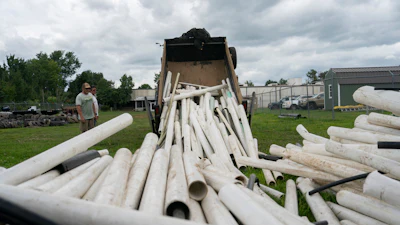
 IPEX PVC pipe is visible at the Buncombe County Landfill, Thursday, September 24, 2026, in Alexander, N.C.AP Photo/Allison Joyce
Removing pipes is tedious, sometimes dangerous
Some of the pipes — both straight, rigid plastic and flexible coils that have unraveled — are under huge piles of tangled logs topped by other debris, often in mounds 20 feet (6 meters) high. Cleanup crews "just sort of picture it as a jungle gym" that they must climb and balance on as they clear the pile, said Jemima Filiss-Cook, who leads the cleanup in Madison County, where most of the pipe is concentrated.
She said many crew members were already cleaning up the river before MountainTrue hired them, as a way of "trauma bonding" over what had happened.
They include avid outdoorspeople, including rock climbers, because the cleanup is "quite a tedious and technical process" that requires a comfort with the rigors of the job, said Anna Alsobrook, MountainTrue's French Broad Riverkeeper.
Crews saw longer pipes into smaller chunks, load them on a boat, then take it downstream to a landing spot where it's loaded onto a truck. Almost all of the pipe goes to a landfill, though some in good condition are given to community members, because there are no good recycling options, MountainTrue said.
"I truly don't think anybody else could do this work except for our debris team members," said Alsobrook, noting they must be able to navigate whitewater rapids with a boat full of pipes and saws.
 Workers from MountainTrue clear IPEX PVC pipe from the riverbank Wednesday, July 22, 2026, in Alexander, N.C.AP Photo/Allison Joyce
The first priority was removing pipes that could pose an immediate danger or entrapment hazard to tubers or kayakers, and much of the remaining debris stranded in flood plains and on banks, especially around riverbends and corners and vulnerable to being washed away in another flood, Stamper said.
But it becomes apparent that many pipes are still in the river whenever the water levels change, he said.
MountainTrue is applying for other grants to help extend its program after state and IPEX funding run out, Stamper said, because it could take years to remove all the debris.
"We're going to do our best as long as the funding allows," he said. "But there's going to be pipe out there that we can't get ever."