For industrial automation designs, the input/output (I/O) signals can be thought of as similar to a biological creature’s nervous system. Inputs come from monitored devices (senses) and outputs are commands sent to controlled devices (muscles), while supervisory digital systems (the brain) handle all the data, ensuring that correct information is directed to and from the appropriate places. This analogy is a bit simplistic, but it illustrates the importance of reliable I/O signaling.
Traditional automation designs commonly used hardwired I/O methods (somewhat equivalent to neurons in our analogy), although in recent years the proliferation of various wired industrial digital communication protocols over Ethernet and other fieldbuses have provided much more capable options for extensive bidirectional data transfer. However, today’s automation designers have an additional connectivity option without a parallel in the animal kingdom—wireless I/O.
Extending the reach
When I/O points are grouped in one or more locations—such as on-board a machine or in a localized manufacturing area—it is convenient to hardwire them to I/O modules located alongside a programmable logic controller (PLC), or to an associated remote I/O (RIO) assembly. This is an exceptionally reliable approach that minimizes costly field wiring.
However, many installations are distributed over distances that make field wiring impractical at best, or prohibitively expensive at worst. Additionally, there are cases during commissioning, testing, or troubleshooting, where a few signals—perhaps a temporary clamp-on flowmeter or an electrical current monitor—need to be observed for just a few days, but there is no practical way to hardwire them.
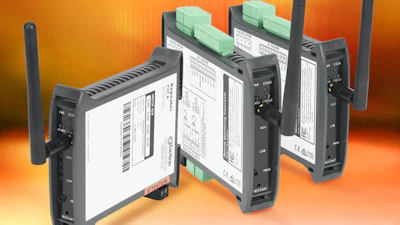
For all these cases, wireless I/O connectivity often provides the best answer. And while there are large-scale wireless technology platforms capable of serving up wide-ranging connectivity throughout an entire site, there is now a more targeted and cost-effective option. This system enables convenient connectivity over useful distances for a handful of I/O points, providing several other beneficial features as well (Figure 1).
Point-to-point wireless
Smallish I/O installations often must handle just one or two analog signals, along with a few discrete on/off points. Translating these I/O points wirelessly over a distance is often enough to support the design needs of a PLC automation or supervisory control and data acquisition (SCADA) system.
To meet these common requirements efficiently, engineers have created a wireless point-to-point system with the following key characteristics:
- Input node, accepting two universal isolated inputs (milliamp, voltage, thermocouple, RTD, potentiometer, and digital pulse).
- Output node, delivering two 4-20mA analog outputs.
- Both input and output nodes also feature discrete I/O in the form of four digital inputs, two digital outputs, and two relay outputs.
- Transmission range up to 0.9 miles line-of-sight between input and output nodes, with the ability to add up to 15 repeaters in between for even greater range, all operating at 2.4Ghz.
- Straightforward software configuration, with nearly plug-and-play simplicity.
The hardware is designed to withstand extreme temperatures and other harsh environmental conditions—including electromagnetic noise—often found in remote locations. DIN-rail mount, along with local or remote antennas, provide installation options, while LEDs indicate wireless link quality and network status. Furthermore, the software facilitates intuitive signal and function selection, using drop-down menus with dynamic sidebar help and the ability to generate clear configuration documentation (Figure 2).
 Figure 2: An emphasis on simplicity and usability ensures this wireless point-to-point solution is easy to use for novices, and helps experts save commissioning time.AutomationDirect
Basic installations may use an input/output node pair to simply pass-through signals, but more advanced capabilities provide extra flexibility for designers, including:
- Analog signals that can be scaled and filtered
- Discrete input/output signal pairs that can be directly associated with each other in transparent mode. They can even be configured as pulse train signals commonly used with flow and energy meters.
- Discrete outputs that act in alarm mode based on setpoints associated with an analog input; this is useful for tripping alarms or alerting operators.
- Discrete outputs that act in control mode to operate equipment such as pumps or heating units (Figure 3).
 Figure 3: The Define Instruments Twin Link wireless point-to-point system offered by AutomationDirect goes well beyond simple I/O connectivity, by enabling advanced signal scaling, alarming, and control strategies.AutomationDirect
While this wireless point-to-point solution is not a PLC control system, it complements automation design, providing a great deal of localized functionality.
Long-distance problem solver
One end user required a diesel-engine-driven pump located in a mine pit to be remotely controlled and monitored at a surface-located PLC/HMI system. By interfacing one pair of wireless nodes, one at the PLC and the other at the engine controller, the design team accomplished the following without any wiring between the two locations:
- Engine start/stop, and run monitoring
- Clutch enable/disable, and engagement monitoring/alarming
- Throttle increment/decrement
- Engine speed and temperature monitoring at the surface
Of course, additional safeguards were designed into this strategy. However, the wireless point-to-point technology enabled a cost-effective solution to be quickly created and implemented, without the need for difficult-to-install field wiring.
Modern digital controls and networking are enabling many forms of advanced industrial automation. However, there remain plenty of situations where targeted problem-solving solutions, such as wireless point-to-point devices, are the best way to create sophisticated solutions, while avoiding problematic installations.
 Rin Irvin, product engineer, AutomationDirect
Rin has worked at AutomationDirect since 2022. He holds a bachelor's degree in Criminal Justice, and is an ISA Certified Controls System Technician Level 3.