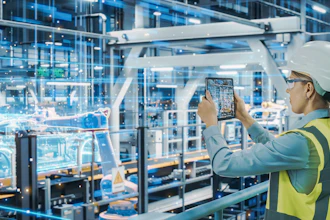
Manufacturers have followed the Industry 4.0 playbook for years, automating tasks and executing them as close to perfect as possible. According to Google Cloud, that playbook is being swapped out for something much bigger.
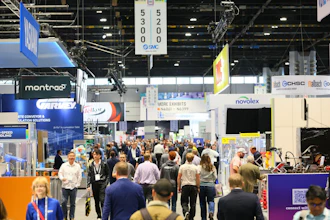
"We are actually bringing in Industry 5.0 methodology, which is basically taking [the industry] from automation to autonomy," said Praveen Rao, director of manufacturing industry at Google Cloud, in an interview with IEN at IMTS 2026 in Chicago. "What we are trying to do is not just automate tasks, but execute a mission of manufacturing."
Industry 5.0 isn’t coming; it’s already here, and Rao pointed to several manufacturers deploying AI agents built on Google's Gemini Enterprise.
For example, Milwaukee-based maker of small engines Briggs & Stratton has built 25 agents that help with change management, orchestrate operations and answer questions along the way. And Honeywell has publicly stated saving about $200 million and cutting time-to-market by 40% to 60% through the use of new AI tools. Rao said some tasks at Honeywell have been compressed from six weeks to four days, using multiple agents for designing, writing proposals and managing projects, by leveraging decades of product development experience.
GE Appliances, which is based in Louisville, Kentucky, recently launched a new "Brilliant Factory" initiative built on 5.0. Rao said the company has released about 800 manufacturing agents that allow workers to essentially talk to a mobile app to get information on operational health and quality issues. GE Appliances has also automated supply chain and logistics, driving a roughly 25% reduction in back orders, according to Rao.
Additionally, FANUC Robotics has incorporated Natural Language Processing (NLP) into its products. The robot maker uses NLP and generative AI in its industrial robotics to enable factory floor robots to comprehend ambiguous spoken or textual commands, perceive their environments, and dynamically coordinate tasks without requiring traditional, proprietary code.
Rao said FANUC has shipped more than 1,000 robots with Gemini built into them, allowing them to process natural language and handwritten notes and coordinate multi-robot work, with one robot picking up where another leaves off.
Lastly, Augury has introduced "industrial profile" built on Google Cloud’s Open Knowledge Format (OKF), an open-source vendor-neutral specification designed to standardize how enterprise context and metadata are formatted for AI agents. It puts a human in the loop and lets operators tell the AI which conditions must be met before an alert is sent. The AI validates those conditions first so, "You don't have death by alerts," Rao said. "You only get the alerts that are actionable."
From systems of intelligence to systems of action
The shift, Rao said, has moved from systems of intelligence to systems of action, and that requires swarms of agents working together.
A plant manager asking what today's production looks like, what problems exist and what they cost needs input from finance, scheduling, quality and warranty teams. Under this contract-based delegation as part of the AI, called a Network Control Protocol (NCP), agents hand tasks off to one another along with the context. Together, they return an answer to the problem.
Not just for large manufacturers
Rao said the approach applies equally to small and midsize manufacturers. "They all want to invent something, make that thing faster, cheaper, better and sell that thing to the right people at the right channel, right price," he said. Whether you are a small firm or a Tier-1 manufacturer, the business problems don’t change.
Because Gemini Enterprise is a no-code, low-code platform, smaller companies can build agents without "an army of engineers" and scale them as they grow.
Closing the skills gap
Workforce remains a major problem. Rao cited industry estimates of 3.8 million open manufacturing jobs by 2033, and onboarding times of two to five years.
Multimodal AI can help, Rao said. Manufacturers can turn SOPs into videos and AI coaches, or turn repair videos into instruction manuals. A generalist can then handle specialized work, with the AI coach validating each task against an expert's standard. Training that once took seven to 10 years can be compressed dramatically. Google calls this "democratizing agents" and allowing citizens to build "citizen agents."
What's next
Over the next five years, Rao expects multimodality to become "the new computer vision," with AI drawing on context such as noise, vibration and harmonics. "We think data semantics is the new assembly line for building agents," Rao said.
Physical AI is another major area. Google has released embodied reasoning and vision-language-action (VLA) models that can read analog signals and sense solids, liquids and gases. Industry consortiums that share trained robot models, along with AI moved to the edge for lower latency, are helping robotics scale faster.
On cybersecurity, Rao said Google's approach is to keep customers in a secure environment from the first experiment onward, rather than securing a solution after it is built. Agents handle threat detection, identification and mitigation.
Ultimately, Rao said, Industry 5.0 reaches beyond the shop floor to design, engineering, supply chain and logistics. Insights from products in use will feed back into engineering, "so that the products are going to continue to get better."