McLean, Va. — With manufacturing technology orders climbing and productivity showing its strongest gains in years, IMTS 2026 will give manufacturers a front-row view of the technologies accelerating the industry’s next wave of growth.
Across the show floor, visitors will experience industrial AI, automation, additive manufacturing (AM), digital twins, software, machining, metrology and connected production systems that are helping companies increase output, improve efficiency and move faster from design to delivery.
The momentum is clear: Through the first four months of 2026, manufacturing technology orders totaled $2.19 billion, up 28.9% from 2025, according to the U.S. Manufacturing Technology Orders Report published by AMT – The Assocation For Manufacturing Technology, which owns and produces IMTS.
The ISM Manufacturing PMI reached 53.3% in June, and the ISM Manufacturing New Orders Index expanded for the sixth consecutive month. The Bureau of Labor Statistics data showed manufacturing labor productivity rose 3.2% in the first quarter of 2026, while output increased 3.3% with no growth in hours worked, a signal that manufacturers are using and adopting technology to increase productivity per worker.
“Production demands and workforce constraints are pushing manufacturers to take a closer look at technologies like AI, digital twins, additive, and advanced automation, all of which are woven through the manufacturing ecosystem at IMTS,” said Mike Cicco, president and CEO of FANUC America and chairman of the board at AMT.
IMTS, which runs Sept. 14-19 at McCormick Place in Chicago, is the largest manufacturing technology show in the Western Hemisphere. Attendees work at OEMs, contract manufacturers, machine shops, and other businesses that comprise the $2.96 trillion manufacturing sector (9.4% of U.S. GDP).
The show encompasses 1.2 million square feet of exhibit space, 10 Technology Sectors, features about 40 million tons of equipment, hosts thousands of live demonstrations, and attracts more than 89,000 people and 1,800 exhibitors.
Because of rapid technology advances, IMTS 2026 will be the first major industry event where visitors can learn how Industrial AI operates across machining, automation, metrology, software, tooling, quality control, AM, production, and planning systems. New attractions include the Industrial AI Arena and the Industrial AI Conference.
“As companies adopt digital technologies, they improve efficiency, increase operational visibility and achieve more consistent results,” continues Cicco. “Visitors to IMTS will see how advances in AI-driven capabilities like vision systems, predictive analytics, and adaptive control can simplify programming and routine tasks, enable employees to take on higher-value responsibilities, and make automation of parts and data more accessible across a broader range of skill levels.”
AMT President Doug Woods predicts IMTS 2026 will be a special show because of the speed and scope at which digital manufacturing technologies are being deployed across every step of production.
“Now is the most exciting time to be in manufacturing,” said Woods, who has spent a lifetime in the industry. “The heart of what manufacturers and job shops do hasn’t changed. We mill, turn, shape, move, measure, and assemble, but new technologies are increasing efficiencies and changing how work gets done. The numbers indicate that people are working smarter, and that’s showing up in factors like the reshoring movement, the manufacturing economy, and the rate of technology adoption.”
What makes IMTS distinct is that these technologies are not presented in isolation: Visitors can see how AI, automation, additive manufacturing, software, machining, metrology, and controls connect across the full manufacturing process, from design and planning to production, inspection, and delivery.
Technology Drives Opportunity, Resiliency
Technology is already changing what manufacturers can achieve. High-performing job shops are using unattended operations to increase machine utilization and revenue, while automation and supply chain efficiencies are helping fuel reshoring and foreign direct investment-related jobs. At IMTS 2026, visitors can see the technologies behind that momentum and evaluate how they can strengthen resiliency, productivity, and growth in their own operations.
“Whatever you do today, you have to look at a more efficient way of doing it, and IMTS helps you figure out what works and what doesn’t,” said Scott Harms, president of MetalQuest Unlimited, a 70-person contract manufacturer that has sent a team to IMTS every year since 1998. “The world needs the United States to be a good manufacturer, given global disruptions and defense industrial base requirements.”
MetalQuest achieves efficiencies through its digitally connected shops and unattended operation using multitasking and digital twin technology from Index, a Hermle 5-axis CNC with an automation package, and a fleet of more than 20 Okuma CNCs paired with FANUC robots.
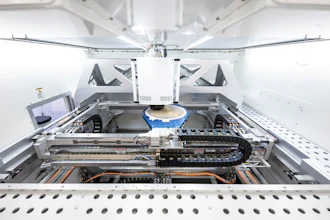
Additive manufacturing (AM) also plays an important role in helping suppliers move away from long, complex supply chains toward more localized, on-demand manufacturing of critical components. At IMTS 2026, EOS will highlight the North American introduction of the EOS M4 Onyx, a next-generation laser powder bed fusion 3D printing platform engineered specifically for industrial-scale production.
“We are working closely with customers and partners across the defense and aerospace supply chain to help address the growing need for faster, more resilient production,” said Patrick Boyd, marketing director of EOS.
Boyd notes that AM advances featured in the Additive Manufacturing Sector include AI-enabled tools that optimize build preparation, automatically orient parts, generate support structures, and simulate builds to predict distortion or failure before printing begins. During production, AI-driven monitoring systems analyze meltpool behavior and sensor data in real time to detect anomalies, helping ensure part quality and repeatability. Post-build, machine learning is being applied to process data to continuously refine parameters, reducing trial and error, and accelerating qualification cycles.
New AI Attractions
IMTS 2026 will make industrial AI easier to understand and evaluate through two new experiences: the Industrial AI Arena, featuring 32 exhibitors focused on AI-driven manufacturing solutions, plus government research leader Sandia National Laboratories, and the new IMTS Industrial AI Conference, a full-day program designed to help manufacturers understand where AI can deliver value in predictive maintenance, quality applications, edge versus cloud deployment, and data readiness.
“IMTS 2026 gives manufacturers direct access to AI experts who understand industrial processes,” said Ryan Kelly, AMT’s vice president of technology. “These companies know how to apply AI to real manufacturing workflows, identify practical opportunities for improvement, and offer new ways to move manufacturers from curiosity to action.”
“I am visiting IMTS to focus on automation integrated with AI to improve our quality and output,” said Tavis Vaughn, vice president of quality and engineering at CNC Machine Products, a company in Joplin, Missouri, that produces bearing races using industrial robots and cobots. “We need our production line to learn and adapt to daily changes so we can operate at the highest levels of efficiency and quality.”
His priorities reflect the questions many manufacturers are bringing to IMTS: how to apply AI to improve quality, productivity, and day-to-day operations.
AI Across the Ecosystem
At IMTS 2026, visitors will see industrial AI at every level of the manufacturing technology stack – from cloud platforms and AI-native applications to embedded capabilities inside machines, controls, software, inspection systems, automation, and digital thread solutions. Hyperscalers such as Amazon Web Services, Google Cloud, and Microsoft will show how cloud platforms, data infrastructure, and AI development tools can connect engineering, operations, and IT systems to deliver role-specific insights for executives, engineers, and frontline operations.
“The real magic happens at the intersection of data from engineering technology, operational technology, and IT software,” said Praveen Rao, global director and manufacturing industry lead, Google Cloud. “By connecting these silos, Google Cloud’s AI platform Gemini Enterprise enables manufacturers to deploy specialized agents that interpret real-time visual and sensor data, preventing downtime before it happens and helping close productivity gaps. This isn’t just optimization; it’s an agentic shift that can build the future of autonomous manufacturing.”
“AI-native manufacturing solution providers create specialized AI solutions for specific use cases,” said AMT’s Kelly. “Visitors will find a concentration of AI-native solutions in the new Industrial AI Arena.” Exhibitors include:
- Atomic Industries, a vertically integrated manufacturing company that handles the entire injection molding process from mold design and tooling through production of finished parts as a single, software-driven organization. Atomic Industries radically compresses cycle times while offering a globally competitive piece price on made-in-the-USA molds.
- Ignizia is an AI-native manufacturing platform that makes industrial AI practical by digitizing a company's operating reality, prioritizing where AI delivers measurable ROI, and enabling it to move from pilot to production with confidence, even when its data and processes are fragmented.
- C-Infinity, whose AutoAssembler AI compiles CAD and PLM information and generates production-ready assembly instructions. It turns weeks of work into minutes and accelerates design and engineering changes, including those for large and complex assemblies.
- Purchaser.ai, which automates and streamlines the RFQ process. Vendor submissions can arrive in any format (PDF, Excel, email bodies) and Purchaser will extract, normalize, and structure each submission into a unified schema, as well as provide assessment analytics.
Embedded AI technology enhances the features and functions of manufacturing technology and creates new capabilities. Examples at IMTS include:
- Automation and robot providers such as FANUC, Standard Bots, Universal Robots, and others will demonstrate how AI elevates automation through easier programming, vision systems with better object recognition, and enhanced motion capabilities.
- Autodesk Fusion CAD/CAM software integrates AI across its workflows to augment creative exploration and problem-solving, automate tedious and repetitive work, and analyze project data to offer predictive insights.
- Hexagon Manufacturing Intelligence is embedding AI into its Esprit Edge CAM platform, introducing tools such as ProPlanAI, which uses historical machining data to predict and optimize processes for new parts. This capability reduces programming time, minimizes errors, and enables less-experienced programmers to achieve expert-level results.
- Heidenhain’s TNC7 control features interactive tools and automation capabilities that streamline CNC program generation and reduce programming time while maintaining the company’s signature precision. A new AI chatbot raises task-oriented support to a new level.
- High QA offers AI-powered software for automatic ballooning (GD&T data in seconds), inspection, reporting (including first-article inspections that are 10 times faster), and 2D and 3D model-based design collaboration.
- Keyence vision systems with advanced detection can learn the difference between product types.
- Mazak, Okuma, Siemens, and other machine tool and CNC control manufacturers use AI to reduce programming and setup time, shorten cycle time, stabilize machining accuracy without human intervention, and diagnose machine operating conditions.