Success at the London Packaging Week 2025 Innovation Awards was about more than proof of concept for PA Consulting, PulPac, and Diageo—it showed the real potential in fiber-based drinks packaging. For many years it has been used in bags, boxes, and cartons and now bottles are being explored.
Fiber-based packaging has long been seen as essential to the future of the packaging industry. It is a readily available, highly recyclable, and easily regenerated material.
However, the porous nature and hygroscopic tendency of fibers have largely limited the use of paper-based packaging to secondary packaging applications (cosmetics and cereal display boxes, etc.) or even tertiary packaging formats (shelf-ready, delivery). That is, until now.
At the London Packaging Week Innovation Awards, PA Consulting, PulPac, and Diageo were recognized in the Sustainable Packaging Innovation category for their ongoing work to develop a lower-carbon, fully recyclable paper packaging for drinks.
Big bet on fiber-based bottles
Bottles are an obvious area where sustainability gains can be substantial. When made from glass, bottles can be energy-intensive to produce, weighty to transport and store, and in some circumstances cumbersome to handle.
However, glass is fully recyclable and can be reused multiple times without loss in quality or purity. There are also ongoing efforts to lightweight glass. Having said that, paper is the most commonly and widely recycled packaging material in Europe. Well-established recovery streams and ingrained consumer behavior mean collection rates for paper-based packaging regularly achieve high double-figures.
If paper could be used to make bottles, it could move the needle towards sustainable and circular packaging.
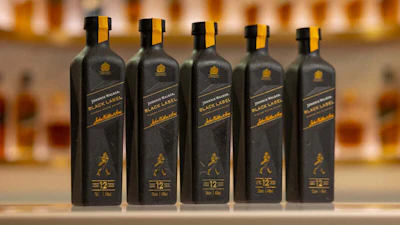
 These bottles of Johnnie Walker Black Label whisky are made from 90% paper. Diageo
In 2023, PulPac and PA Consulting launched the Bottle Collective—Diageo is a founding member. One of the collective's goals is to create a fiber bottle alternative to help minimize the use of single-use plastic bottles in food, drink, consumer health, and fast-moving consumer goods (FMCG) industries.
PulPac’s Dry Molded Fiber technology and uses renewable pulp and cellulose resources to produce low-cost, high-performance fiber-based packaging. The patented manufacturing process uses less carbon dioxide than plastic and conventional wet molding options. Almost no water is used in manufacturing to create a highly versatile container mold for brands and retailers.
While a thin plastic liner is still required, it is not bonded to the fiber layer, to make it easier to separate during recycling and to allow use with almost any mechanical process. This can even occur during curbside collection, with the pressure from collection vehicles enough to easily separate the liner from the outer layer. However, collection and sorting processes vary by geography, and the infrastructure is not in place everywhere for these bottles—the collective is working on that too.
Tony Perrotta is a sustainability and regenerative economy expert at PA Consulting. He believes the Bottle Collective has been essential to breaking through with paper bottles that have the potential to scale effectively.
“Sustainability wins that cannot ultimately be industrialized at meaningful volumes will not satisfy brand owners or regulators,” he said. “We knew that this could not be a curated ‘lab trophy’. While it is a bold innovation, there needed to be clear line of sight into producing millions of bottles at the speed, scale, and cost the industry requires. As a collective, that remains the direction of travel, and for Diageo’s products specifically, we are still validating what that pathway looks like in practice.”
A self‑funded stage of the development process enabled PA Consulting to effectively de‑risk the concept, build early prototypes, and gather data that convinced global brand owners such as Diageo that a high‑performance fiber bottle was feasible.
“No matter how strategically important, no one client is going to foot the bill for such a large project. But what if you split this among six, seven, or eight different partners? Suddenly, that becomes palatable and easier to digest,” Perrotta added.
It was also necessary to involve those building the lines that produce and fill bottles into the project at an early stage. This includes welcoming Logoplaste and Krones, among others, as technology partners into the Bottle Collective.
Perrotta added, “By tapping into specialist engineering partners instead of trying to design everything from scratch, we avoided reinventing the wheel all over again.
Success on the shelf (and on stage)
The Bottle Collective is a "very uncommon" model, but one that could become more common. "Tackling systemic packaging challenges requires shared platforms, shared risks, and new governance models, not just individual R&D projects,” Perrotta said.
For leading beverage brand Diageo, participation in the Bottle Collective has led to a live consumer trial in real-life conditions of a 70cl paper bottle made from 90% paper for its Johnnie Walker Black Label whisky. This makes it around 60% lighter than glass alternatives, with almost half the CO2e.
Paper will always be less robust than glass and tests like this are important to learn how the bottles survive in real environments. For a premium whisky like Johnnie Walker Black Label, aesthetics and environmental metrics are only part of the equation. The pack must also protect product integrity under strict regulatory requirements. Ahead of Diageo’s market trial, the partners performed extensive testing for alcohol loss. Spirits are heavily regulated. Any mass loss in the bottle could changes the proof level and cause the product to fall out of compliance.
For the flavor, Diageo’s specialists set a non‑negotiable bar. “We had their flavor specialists constantly ensuring the product tasted like Johnnie Walker throughout the development and commercialization process to make sure we didn’t taint the product,” Perrotta added. “The fiber bottle had to pass the same rigorous sensory scrutiny as any new glass format, and we were able to pass those tests.”
In a drinks category facing multiple headwinds, Perrotta expects the Johnnie Walker project and others like it to act as a catalyst for more of the industry to embrace paper-based solutions. Johnnie Walker has shown that paper bottles can convey a sense of luxury and high quality previously thought impossible to achieve with fiber-based alternatives.
“Not only are we disproving this, in some cases we've added luxury cues that you wouldn't have had otherwise," Perrotta said. "This is helping non‑alcoholic beverages and mainstream FMCG brands have the line of sight that enables the consideration of other materials."
 For the flavor, Diageo’s specialists set a non‑negotiable bar. Diageo
Success in the London Packaging Week 2025 Innovation Awards for the Johnnie Walker Black Label molded fiber bottle was proof in action and cemented the project as one of the boldest, most creative, and most sustainable activations of the previous 12 months.
The window is now open for the next innovation that demonstrates the packaging industry's progress towards a sustainable, circular future.
Jamie Stone, design and sustainability expert at PA Consulting, said, “Breakthrough innovation takes a lot of time, and it takes a lot of partnership. Having big brands like Diageo and others sponsor our technology helps us move forward. Every technology needs to reach a wider audience, and you need people to understand it. Winning awards is a great indication that we're on the right track, step by step.”