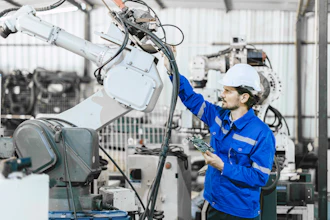
Low-volume manufacturing for robotics parts is needed to give developers the ability to make rapid design changes. Developing robotic parts requires precision in positional accuracy, flatness, weight and assembly consistency across joint, housing, mount and structural components. Achieving this level of precision consistently, run after run and revision after revision, depends more on building a disciplined CNC milling process for small production runs than on simply having available machine capabilities.
5-Axis Machining Reduces Setup Error on Joint and Housing Parts
Jointed robotics parts and transmission housings rely on very close positioning relationships between surfaces and holes on opposite sides of the component. For example, a mounting bore hole may be on one face, a bearing seat on an opposing face, and a datum or reference plane somewhere in between. To machine these types of components using individual set-ups for each feature, you must re-establish the correct orientation of the component relative to the fixture after each feature is machined. Each additional time the fixture is used (i.e., re-fixturized), errors from previous set-ups accumulate, which can make it difficult to meet very tight tolerance requirements.
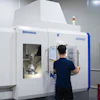
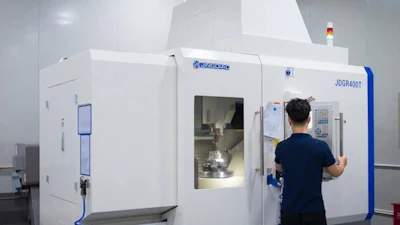
5-axis machining allows engineers to address these issues by reaching multiple faces from a single setup, maintaining the orientation relationship between all features and their respective datums. Wayken Rapid Manufacturing has successfully employed this strategy to create articulated-arm-type components with internal passages, thin-wall sections, and very limited machining access.
Controlling Deformation in Lightweight Aluminum Structures
In robotics, lightweight housing and structure require thin-walled aluminum geometry. It also creates a new problem. Thin walls create deformation or bowing from uneven release of internal residual stresses created during the process of machining parts from raw stock. Heavy parts do not experience these issues because their larger cross-sectional area allows them to withstand the forces exerted by machining; therefore, they deform less and produce fewer errors.
 WayKen Rapid Manufacturing
Simply applying more clamping pressure will not solve this issue. Excessive clamping pressures will create additional deflections or deformation in the thin wall being milled. These deflections will completely reverse themselves when the part is removed from the mill. Therefore, a better solution to prevent this type of deformation would be to sequence the operations. For example, first complete all roughing cuts to allow the material to relax evenly. Then, make finishing passes in a subsequent operation, allowing time for the stresses to stabilize before taking the last cuts. This is routine in CNC milling services for aluminum robotics parts like AL 6061-T6 housings, where dimensional stability matters as much as the alloy's machinability.
Inspection Protects Assembly and Batch Consistency
Statistical sampling methods are useful when a large batch may contain one or two outliers. For example, lower-volume robotics runs typically produce 10-20 units and do not have such flexibility; therefore, if an individual dimension is off by some amount, a significant number of items could be affected, with little room to absorb the defect before reaching the assembly process.
 WayKen Rapid Manufacturing
Therefore, Wayken rapid manufacturing employs full inspection, rather than spot checks, for all small-batch precision parts. Additionally, these parts undergo a design review before machining begins to identify any tolerance conflicts as early as possible. This approach to quality control is used for all low-volume robotic work, in addition to first-article inspection, to ensure each part's integrity is evaluated in detail before shipping. Sampling-based inspections were developed for much larger batch sizes.
Conclusion
Robotics components require the accuracy of production machining at prototype batch sizes. Meeting both at once takes deliberate setup strategy, deformation-aware sequencing, and inspection scaled to small lots — the combination that makes WayKen rapid manufacturing workable for parts that rarely get a second production run to fix what the first one missed.