According to the FBI, estimated cargo theft losses in the U.S. and Canada reached nearly $725 million in 2025. This was a 60% increase from estimated losses in 2024. Cargo theft is a growing international crisis that companies need to address immediately to avoid mounting losses.
Cyber technologies are advancing to make it even easier for criminal organizations to trick shippers into transferring cargo to them versus using brute-force takeovers to commandeer shipments. As thieves become savvier, companies need to add layers of defense across the organization, from cyber protocols to automated perimeter security technologies.
The Means and Methods of Cargo Theft
Law enforcement has defined cargo theft in four categories: straight cargo theft, strategic cargo theft, cyber cargo theft, and pilferage cargo theft. In scenarios where an entire shipment is stolen from a truck, warehouse, rail yard, or distribution center, that is considered straight cargo theft. When only a portion of a load is taken, that is defined as pilferage.
More sophisticated cargo theft crimes are the strategic and cyber methods. Strategic attacks are when criminal organizations use fraudulent and deceptive tactics to trick shippers and carriers into transferring loads. This can involve trucks with fake license plates and identification numbers, manufactured paperwork and worker identifications, and other methods of deception.
On another level, cyber cargo theft relies on phishing campaigns and other digital intrusions to steal authentic shipping information to enable criminals to intercept loads by redirecting shipments, transferring loads to other vehicles, or changing driver names and contact information.
Cargo theft can happen at any point of the supply chain. Thieves could target a truck parked for the night alongside a highway or at a truck stop and pilfer the load. Or they could send in a masked truck and a plant driver to be loaded with goods that never make it to their intended destination.
 Mission Control is the brain behind Birdstop drones. On-board AI handles real-time detection, classification and dispatch, while one operator runs multiple systems from a single console.Birdstop
Reexamining Perimeter Security
Traditionally, warehouses, trucking and rail yards, and other stops along the supply chain have been protected by fencing, gates, security patrols, and static cameras. However, as criminals’ methods are evolving, these security methods have become less effective.
Modern logistics facilities can span hundreds of acres, making continuous monitoring difficult and expensive. Warehouses, trucking depots and railyards often operate 24 hours a day, creating additional security challenges at night and in low-visibility conditions.
Staffing security teams can also be difficult. The security industry has a shortage of personnel. Few people want to work in situations that threaten their health and life, and even fewer want to work long overnight shifts.
Fixed cameras only monitor specific locations and can leave blind spots. Security personnel cannot be everywhere at once. Depending on terrain and accessibility, patrol vehicles can take anywhere from a few minutes to 30 minutes (or longer) to reach a remote section of a property after an intrusion is detected.
Criminals understand these security challenges and limitations and have become adept at exploiting them. Organizations need solutions that can improve visibility, monitoring and response times across vast footprints with low maintenance and human involvement, exactly what unmanned aerial vehicles (UAVs) can provide.
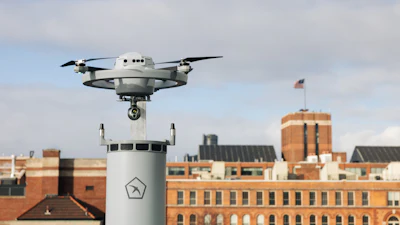
 Drones can provide continuous or scheduled aerial patrols around facility boundaries.Birdstop
Understanding the Benefits of Drones
One of the most obvious benefits of drones is that they provide security teams with a mobile, responsive view of large sites. When an alarm is triggered, or a static security camera detects an anomaly, drones can be deployed to the scene to investigate within seconds, whereas human security patrols can take minutes to respond.
Equipped with advanced cameras and sensors, drones can deliver real-time video feeds to security teams either onsite or in remote monitoring facilities. Security personnel can immediately review live video feeds, assess the situation and determine whether an intrusion, theft attempt or false alarm is occurring. This capability allows security teams to make informed decisions while reducing response times and improving operational efficiency.
Drone security is not solely reactive. Drones can be stationed and perform like fixed security cameras, with enhanced benefits like listening capabilities. They can also provide continuous or scheduled aerial patrols around facility boundaries, helping security teams identify vulnerabilities in fence lines and access points before they are exploited. This reduces wear and tear on security vehicles. Drones can also detect breaches in fence lines that may be invisible to the human eye.
Using high-resolution optical cameras, drones can even detect unauthorized individuals approaching fences, gates or restricted areas. Many systems integrate with existing perimeter sensors and automatically launch when suspicious activity is detected, providing eyes in the air for further examination.
By offering a live aerial view, drones enable operators to track intruders as they move across a property. This real-time intelligence helps security personnel coordinate responses and maintain visual contact with suspects until law enforcement arrives.
Finally, drones can detect threats better at night and in low visibility than human security patrols. Many cargo theft incidents occur after dark when facilities are less active, and visibility is reduced. Drones can be equipped with thermal imaging cameras that detect heat signatures from people, vehicles and equipment. Thermal technology allows operators to identify suspicious activity even in complete darkness, fog or challenging weather conditions.
 When an alarm is triggered, or a static security camera detects an anomaly, Fealty drones can be deployed to the scene to investigate within seconds.Birdstop
A Layered Defense Against Cargo Theft
As cargo theft continues to evolve, security strategies must be enhanced with robotics and artificial intelligence to combat new and growing threats as thieves implement AI and other technologies to make their crimes more efficient and effective.
Drones can give logistics operators faster response times and clearer visibility across warehouses, trucking depots, railyards and distribution centers.
While drones are not a replacement for traditional security measures, they significantly enhance the effectiveness of existing programs. By combining aerial awareness with ground-based security systems and teams, organizations can create a layered defense that is better equipped to deter, detect and respond to criminal activity.
 Keith Miao is the founder and CEO of Birdstop.Birdstop
Keith Miao is the founder and CEO of Birdstop, an American manufacturer of drone technology for government and industry. Prior to founding Birdstop, Miao led a data science team at Google. His career in remote sensing began with satellite imagery research at the Columbia University Earth Institute.