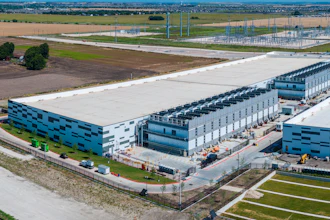
The rise of artificial intelligence and the growth of cloud computing are driving demand for new, high-performance data centers. In manufacturing, for example, the ability to collect, store and analyze vast amounts of data is becoming increasingly critical for daily operations. Data centers need more servers, but they also require more powerful ones.
Processing an ever-growing amount of data requires more power, but more power generates more heat – the enemy of reliable electronics. Because data center capacity is limited by the effectiveness of data center cooling technology, traditional approaches to thermal management may not be enough.
Fans and heat sinks are cost-effective, but they cannot meet the large-scale cooling requirements of concentrated high-power computing. Air conditioning and air handling are used at the facility level, but they can be energy intensive.
Water-based liquid cooling can be used because water is thermally conductive, meaning that it moves or transfers heat. However, this method has certain challenges. For example, water levels must be closely monitored and maintained because leaks may develop or evaporation may occur. Also, during normal data center operations, water usage is significant, which raises environmental concerns.
According to the Environmental and Energy Study Institute, a medium-sized data center can consume up to 110 million gallons of water per year, while a large facility can consume over 5 million gallons of water per day.
Consider Thermal Immersion Cooling
Thermal immersion is an alternative liquid cooling method that can promote environmental sustainability and operational efficiency in data centers. According to Mordor Intelligence, a market research firm, thermal immersion cooling enables a 91% reduction in water consumption and a 39% reduction in carbon emissions. Data centers can also achieve a total cost of ownership savings of up to 30%. Plus, this cooling method requires 85% less physical space and can improve the lifespan of IT hardware by 20%, according to Mordor Intelligence.
Power usage effectiveness (PUE), a metric that describes a data center’s energy efficiency, also improves. In basic terms, PUE is the ratio of a data center’s total energy consumption to the energy consumption of its IT equipment. The ideal PUE is 1.0.
According to BIS Research, the PUE for immersion cooling is slightly greater than 1.0. That is lower than computer room air conditioning and air handling systems (1.8), in-row cooling systems (1.4), rear door heat exchangers (1.3) and direct-to-chip cooling (1.2).
Unlike other cooling methods, thermal immersion cooling submerges full servers or server components in a thermally conductive liquid that transfers heat from a coolant to a water circuit. Ideally, this coolant has low electrical conductivity so that it will not interfere with server operations.
Although de-ionized water can be used, water is not the best choice for a dielectric fluid. This is because water contains charged ions, making it a very good conductor of electricity.
Traditional Thermal Immersion Coolants
Traditionally, fluorocarbons, hydrocarbons (synthetic oils) and pure silicone fluids have been used as thermal immersion coolants in data centers. They each have advantages but also raise various concerns.
For example, fluorocarbons are relatively expensive and can be difficult to keep at proper levels because of evaporation and leakage. Although they are non-flammable, fluorocarbon coolants have a relatively high global warming potential and ozone depletion potential.
Some fluorocarbons are per- and polyfluoroalkyl substances (PFAS), a class of manufactured chemicals known as forever chemicals because they persist in the environment for decades or even centuries and accumulate in soil, water and living organisms.
Today, some manufacturers are voluntarily removing PFAS from their materials and products. In the United States, PFAS regulations are changing and include federal actions and a growing number of state-level initiatives.
Synthetic oils cost less than fluorocarbons and resist leaking; however, they lack thermal stability, are flammable, and can cause polymers and elastomers used in electronic components to swell. By comparison, pure silicone fluids offer advantages in terms of thermal management, fire safety, cost and ease of maintenance.
Yet silicone fluids are incompatible with the silicone-based materials used in some server electronics. Examples include silicone adhesives, encapsulants and thermal gels. Silicone fluids can cause these other silicone materials to swell, and changes to shape and size generate mechanical stress.
Next-Generation Hybrid Thermal Immersion Coolants
Today, new thermal immersion coolants that use a hybrid silicone and hydrocarbon chemistry are addressing each of these challenges. For example, these novel materials are non-flammable and have a low risk of leakage because of their broad compatibility with electronic materials, including elastomeric seals and gaskets.
In turn, this reduces the need for fluid replacement and supports ease of maintenance. Hybrid coolants that are designed to have low toxicity can also simplify handling and disposal.
Compared to pure hydrocarbons, hybrid thermal immersion coolants offer greater thermal stability. This allows them to withstand the higher temperatures associated with new, high-performance data centers and their heavier workloads.
The improved chemical stability of hybrid coolants makes them less likely to break down over time. By maintaining their material properties, these advanced materials support longer service life and more reliable performance.
Finally, hybrid thermal immersion coolants can contain additives that protect against rust and corrosion on metal surfaces, a benefit that helps to maintain the integrity of pumps, radiators and other system hardware. With their high shear resistance, hybrid coolants are also likely to break down from the mechanical stress of being pumped through the system.
The Future of Data Centers
As AI and cloud computing continue to grow, the data industry is projected to enjoy a compound annual growth rate (CAGR) of 11.8% through 2030, according to market research firm Grand View Research.
Data center designers and builders have a choice of cooling methods, but thermal immersion cooling has a superior PUE and can reduce water consumption significantly.
Furthermore, thermal immersion cooling that uses a hybrid silicone and hydrocarbon chemistry can promote environmental sustainability and efficiency while addressing challenges posed by other coolant types.
Jason Wei has been with Dow for 17 years engaged in application and formulation development of silicone rubber, adhesive, coating, potting and thermally conductive materials for Dow’s consumer electronics and photovoltaic applications.