For many growing companies, the accounting department becomes a pain point long before leadership realizes how much it is holding the business back. Financial reporting slows down, forecasting becomes inconsistent, and internal teams spend more time reacting to problems than planning ahead. Hiring an entire in-house finance department sounds like the obvious answer, but for many manufacturers, distributors, and operationally complex companies, that route is expensive, difficult to scale, and hard to manage effectively.
TGG Accounting works with companies that want stronger reporting, better financial visibility, and leadership-level accounting support without taking on the overhead of building a large internal department from scratch.
Modern Accounting Requires More Than Bookkeeping
Many companies outgrow traditional bookkeeping faster than expected. Once operations become more complex, leadership teams need deeper financial insight to make confident decisions. Manufacturing companies especially face pressure from fluctuating material costs, inventory management issues, labor expenses, and cash flow planning challenges that require accurate reporting in real time.
This is one reason outsourced financial teams are becoming more attractive to executives trying to modernize operations. Instead of hiring multiple employees internally, companies can access controllers, CFO-level insight, and accounting specialists through a structured outsourced model.
“TGG Accounting stands out because they go beyond traditional accounting. Their team provides real financial strategy and guidance that helps businesses scale. The reporting is clear, communication is excellent, and they truly operate like an extension of your leadership team.” - Sierra S.
TGG Accounting focuses heavily on operational industries where complexity tends to increase quickly. Their work with manufacturers includes support for inventory tracking, margin visibility, financial forecasting, and process optimization. Businesses searching for manufacturing accounting services are often trying to solve problems that extend far beyond monthly bookkeeping. They need systems that support growth while giving leadership a clearer picture of overall financial performance.
“TGG Accounting has been an incredible partner for our business. Their team doesn’t just handle bookkeeping — they provide real strategic financial insight. From cash flow forecasting to monthly financial reporting, everything is organized and easy to understand. If you’re looking for outsourced accounting or CFO-level guidance, I highly recommend TGG.” - Hadrian S.
Why Building an Internal Department Is Not Always Efficient
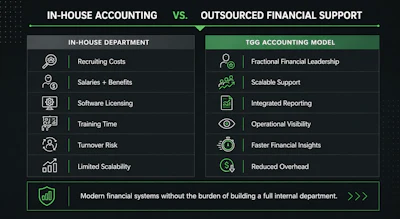

There is a common assumption that hiring internally creates more control. In reality, many companies discover that building an accounting department internally creates new operational headaches. Recruiting experienced accounting professionals is competitive and expensive, especially for businesses outside major metro areas. Even after hiring, companies still face training costs, turnover risks, software integration issues, and ongoing management responsibilities.
For companies already focused on scaling operations, production, or expansion, managing an entire finance infrastructure internally can drain time and resources quickly.
Instead of building a department piece by piece, companies gain access to an established system with experienced professionals already in place. Leadership can focus on operations while the accounting structure scales alongside the business.
The financial side matters too. Many executives begin comparing the long-term cost of ownership tied to salaries, benefits, software subscriptions, onboarding, and internal inefficiencies. In many cases, outsourced accounting provides broader expertise at a lower overall operational cost than staffing multiple full-time internal positions.
Technology and Visibility Are Driving the Shift
Modern accounting departments depend heavily on technology integration. Delayed reporting and disconnected systems can create serious operational blind spots, especially in manufacturing and distribution environments where timing affects profitability.
TGG Accounting emphasizes financial visibility through structured reporting systems and scalable accounting processes. Rather than offering one-size-fits-all bookkeeping, the company works to align accounting operations with the way a business actually functions day to day.
That operational focus matters because many business owners do not just want reports. They want clarity. They want to understand where margins are shrinking, where inefficiencies are developing, and where growth opportunities exist before problems become expensive.
This is part of the reason outsourced accounting firms have evolved so rapidly over the last several years. Businesses no longer view accounting as a back-office necessity alone. Financial systems now directly influence strategic planning, hiring decisions, expansion efforts, and operational efficiency.
Companies researching TGG-Accounting.com are often looking for a partner capable of supporting both immediate accounting needs and long-term financial structure. That includes everything from monthly reporting support to higher-level advisory services that help leadership make more informed decisions as the business grows.
The Push Toward Smarter Financial Infrastructure
Business leaders are under pressure to move faster while maintaining tighter control over costs and performance. At the same time, financial operations have become more demanding. Between compliance requirements, reporting expectations, and operational forecasting, accounting departments now play a much larger role in business strategy than they did a decade ago.
Instead of viewing outsourced accounting as temporary support, many businesses now see it as a scalable long-term solution that provides stronger expertise, better systems, and improved visibility without the burden of building an oversized internal department. For growing manufacturers and operationally intensive businesses, modernizing accounting operations is no longer optional. It is becoming part of staying competitive.