In the food and beverage industry, there’s zero tolerance for underperforming equipment. If your machinery can’t deliver top-tier hygiene, safety and efficiency, it won’t make it past the prototype stage — and if it somehow does, recurring line shutdowns will crush your margins.
Surprisingly, one of the biggest culprits behind those costly disruptions is often overlooked: bearing failure. The wrong bearing design can grind an entire production line to a halt. What seems like a small design choice can quickly snowball into mounting repair costs, unplanned downtime, missed deliveries and eroded customer trust.
This happens more often than you’d think — especially when engineers underestimate how critical bearings are to uptime and product safety. Bearings in food and beverage operations face harsh cleaning chemicals, temperature extremes and constant exposure to moisture and impact. The wrong selection isn’t just a maintenance issue — it’s a business risk
In this recent article from the engineers at Boca Bearings, we’ll break down the essential bearing design considerations for food and beverage environments —from materials and lubrication, to sealing and sanitation. You’ll learn how the right decisions will extend uptime, lower maintenance costs and protect your bottom line from contamination and shutdowns. Most importantly, your bearings won’t be the reason if your operation fails.
 Boca Bearings
Demanding Applications Across the Industry
Bearings in the food and beverage industry must withstand a variety of harsh conditions depending on their specific application. Each application has its own unique challenges. Examples include:
Food processing equipment: Mixers, slicers and conveyors face high temperatures and frequent washdowns. Bearings must withstand these conditions while maintaining high performance and hygiene.
Beverage processing: Bearings in bottling, filling and packaging operations must resist corrosion and maintain their structural integrity when exposed to acidic or alkaline cleaning agents. The rise of microbreweries has increased the demand for mobile canning operations to support local distribution. In canning equipment, bearings are used in seaming and lifting mechanisms, where they are often directly exposed to acidic beverages. Unfortunately, traditional sealed bearings often corrode when exposed to acids in drinks, leading to frequent replacement.
Dairy processing: Dairy machines undergo rigorous cleaning to prevent contamination. Bearings must be able to resist chemical exposure and endure frequent washdowns without compromising their performance.
Bakery and confectionery; In this sector, bearings are used in equipment like ovens and conveyor belts and must therefore operate under both high and low temperatures. Despite these extreme conditions, they must perform with the utmost reliability.
Meat and poultry: Bearings used in meat and poultry processing must withstand harsh cleaning processes to prevent contamination, necessitating designs with corrosion-resistant materials and advanced sealing technologies. Operations like slaughterhouses present particularly unique challenges, as the transfer of large carcasses to conveyors creates impact loads that can damage components.
Seafood and frozen foods: These bearings must be able to handle very cold — even subzero — conditions. At the same time, they must maintain performance while preventing contamination.
Choosing the Right Bearing Material
To withstand the harsh conditions present in these and other food and beverage applications, the material you select for your bearing is essential. Stainless steel is the most common choice due to its exceptional corrosion resistance and compliance with food safety standards. These bearings maintain their structural integrity in environments where frequent washdown and exposure to acidic or alkaline cleaning agents are present, making thema preferred choice for many food and beverage processing applications.
Another material option for food-grade bearings is engineered plastics, such as polyether ether ketone (PEEK) and polytetrafluoroethylene (PTFE), which feature excellent wear resistance and minimal friction. These materials are non-magnetic, non-conductive and can operate without lubrication, making them ideal for sensitive environments like bakery and confectionery production. Plastic bearings are gaining popularity in applications requiring lightweight, cost-effective and chemically resistant components.
Due to their self-lubricating nature, they can also operate without additional greasing, which reduces maintenance time and costs and eliminates the risk of contamination in food-handling applications.
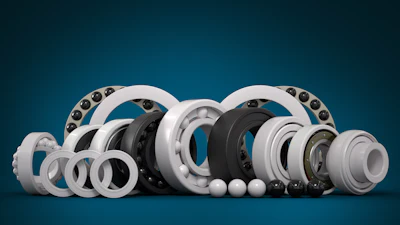
Ceramic bearings are increasingly being used in food and beverage equipment design because of their exceptional durability, corrosion resistance and ability to perform under extreme operating conditions. With balls that measure roughly twice the Rockwell hardness of steel, ceramic bearings offer superior longevity and wear resistance. Their smoother, spherically precise rolling surfaces also minimize friction — translating to greater efficiency, less energy consumption and reduced maintenance requirements over time.
 Boca Bearings
As an industry leader in ceramic bearing technology, Boca Bearings has seen this shift firsthand —helping equipment designers replace traditional steel components with high-performance ceramic alternatives that stand up to harsh cleaning agents, temperature swings and continuous operation. Hybrid bearings combine different materials, balancing the best qualities of durability, corrosion resistance and cost efficiency. For instance, bearings with stainless steel races and ceramic balls offer better wear-resistance with minimal friction, and area suitable alternative to full ceramics in applications with high impact loads. The steel races can withstand the impact, while the ceramic balls provide the benefits of chemical resistance and low friction.
Considering Total Cost of Ownership
While the upfront cost of advanced bearing materials may be higher, ceramic and hybrid bearing solutions often deliver far greater value over time, especially when you consider the total cost of ownership. A two-dollar bearing that fails mid-production can halt a conveyor line for hours, creating huge costs in downtime, scrap and wasted labor hours, often exponentially more than the component itself.
At Boca Bearings, we’ve seen this play out far too many times — getting called in after a failure to help redesign systems that could have avoided the shutdown altogether. In nearly every case, the problem wasn’t the equipment; it was the wrong choice of bearing.
From this perspective, here’s a rundown of the benefits of ceramic and hybrid bearings:
Reduced downtime. Ceramic bearings typically last twice as long as conventional bearings, reducing maintenance requirements and production interruptions.
Energy savings. The lower friction of ceramic balls can reduce energy consumption in a measurable way across an entire plant.
No lubrication contamination. Dry-running capabilities eliminate the risk of lubricant contaminating food products.
Extended maintenance intervals. Eliminating lubrication also reduces the frequency of bearing maintenance and replacement.
Application -Specific Recommendations
An understanding of various bearing materials will help you make a more informed selection. Here are specific recommendations for common food and beverage scenarios:
High-impact applications: In operations with high impact loads — such as slaughterhouses or heavy-duty conveyors — hybrid ceramic bearings provide the best balance of durability and performance. Unlike full ceramic bearings, which could shatter under the loads, the hybrid solution’s steel races absorb impacts while the ceramic balls deliver corrosion resistance and minimize friction.
Submerged or heavy washdown environments: Full ceramic bearings excel in applications where bearings may be submerged in processing liquids or be exposed to intense washdown procedures. Their ability to operate without lubrication also eliminates contamination risks entirely.
High-temperature operations: Commercial ovens, pizza ovens and bakery equipment benefit from full ceramic bearings, which maintain performance and structural integrity under high heat.
Precision filling and packaging: The filling sections of production lines can experience dramatic improvements when upgrading to ceramic bearings, which tackle the combination of chemical exposure, frequent washdowns and precision requirements.
Applications with sustainability requirements: The friction reduction benefits of ceramic technology can lead to significant energy savings. For example, one yogurt company that switched their plant to ceramic-hybrid bearings reported a measurable decline in energy consumption.
Additional Design Considerations: Seals and Lubrication
Beyond material composition, there are other design considerations that can make or break bearing success in food and beverage environments. For example, non-magnetic properties ensure that the bearings won’t interfere with sensitive equipment.
Seals also play an important role, acting as barriers that keep lubricants in and contaminants out. Common seal materials include nitrile rubber, Viton, PTFE, labyrinth and stainless steel, each one offering unique advantages depending on the application:
Nitrile rubber seals: Commonly used for general-purpose and high-temperature applications. They are resistant to petroleum-based oils and hydraulic fluids.
Viton seals: Made from fluorocarbon rubber, they offer superior chemical resistance — especially in environments with acids, silicone fluids and aromatic hydrocarbons. Viton is also suitable for high-temperature applications.
PTFE seals: Offer excellent chemical resistance, high-temperature tolerance and low friction. PTFE’s hydrophobic nature and low moisture absorption makes the material easy to clean.
Stainless steel shrouded seals: Feature additional durability and abrasion resistance for additional protection in harsh environments and high-impact scenarios.
Labyrinth style seals: Rely on gaps and passages to block contaminants from entering the bearing. These non-contact seals feature low friction and are ideal for high-speed operations.
For food applications that do require lubricated bearings, innovations in lubrication technology have led to longer-lasting solutions that enhance bearing performance, reduce maintenance requirements and comply with food safety regulations. For example:
Ultra Dry Lube (UDL) is an extensively modified lamellar composition that adds less than half a micron to any metal substrate. It molecularly bonds to most materials and is inorganic, non-toxic, non-corrosive and resistant to most fuels, solvents and acids.
Lightning Solid Lube (LSL) includes solid Polyethylene and Graphite lubricants designed to provide long-lasting performance in challenging environments.
Conclusion: Engineering Reliability from the Inside Out
Selecting the right bearing for food and beverage equipment isn’t just about matching specs — it’s about understanding how design choices performing the real world. When standard products don’t fit the mission, look for application-specific solutions built for harsh, high-demand environments.
For more information, visit www.bocabearings.com.