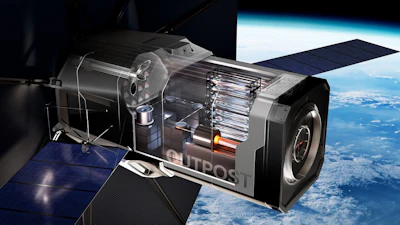
Outpost Technologies today introduced Space Factories, a program that lets companies manufacture products in orbit and return them to Earth without building a space program of their own.
Instead of developing a bespoke spacecraft, reentry system and recovery operation for a single mission, companies bring their manufacturing process to Outpost's standardized, reusable platform; turning space manufacturing into standardized infrastructure they can specify rather than design and build.
A growing list of products from specialty optical fibers to pharmaceuticals, semiconductors and advanced crystals can be made better, or only, in microgravity. To date, every attempt to produce them in orbit has been a one-of-a-kind effort, with each company re-solving the same problems of power, thermal control, containment, safety and return from scratch. Space Factories lets customers focus on developing products, while Outpost provides a common industrial platform: standardized modules that reduce bespoke engineering, shorten development timelines, and allow far more rapid deployment.
The company said that, after production, bringing things back from orbit is its core capability, which makes it uniquely positioned to close the loop from orbital manufacturing to recovered product on the ground.
"No company should have to become a spacecraft company just to find out whether their product is better when it's made in space," said Amir Blachman, President and co-founder of Outpost. "We're designing and building the hard, expensive infrastructure: the vehicle, the power and thermal systems, standardized manufacturing modules, the reentry and recovery; and we operate it as a service."
Outpost is putting the platform to work, manufacturing its own products in orbit. StarFiber, the company's metal fluoride optical fiber, will be produced in a Space Factory module. Metal fluoride fibers can achieve lower signal loss than the silica fibers that carry today's data and telecommunications traffic, but they are extremely difficult to manufacture at quality on Earth, where gravity introduces defects during production. Microgravity offers a path to producing them at the quality their performance promises. StarFiber's formulation is also radiation-hardened, making it well suited to satellite, defense, and other demanding environments (and it will demonstrate the full Space Factory model end to end, from orbital production to recovered product on the ground).
"StarFiber is how we prove the platform on ourselves before we ask anyone else to fly on it," said Ryan Reel, VP of Commercial Partnerships and Product Strategy at Outpost. "It's the same infrastructure, the same modules, and the same return path we're offering to every customer. Any company developing a product that benefits from microgravity can plug into a platform we've already flown and get to orbit far faster and for less cost than they could on their own."