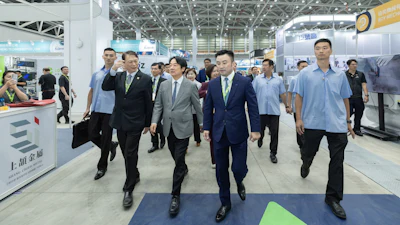
inspect exhibitor booths and learn about the latest R&D achievements in Taiwan's hand tool and smart manufacturing industries.
TAICHUNG—Taiwanese President Lai Ching-te commended the country’s hardware and tools industry, which reportedly saw 2,500 manufacturers export nearly $3.4 billion worth of products in 2025, at this year’s Taiwan International Tools & Hardware Expo x International Hardware Expo Taiwan (TiTE x IHT) in Taichung.
The expo came after Taiwan’s government introduced new measures to help manufacturers expand into overseas markets.
“Taichung plays a relaxed, leading role in the drama,” Lai said through an interpreter. Taiwanese President Lai Ching-te speaks at TiTE x IHT in Taichung.Nolan Beilstein
In response to U.S. tariff adjustments and global supply chain restructuring, the country’s Ministry of Economic Affairs launched an initiative in December 2025 with a budget of nearly NT$10 billion ($305.1 million). The program includes support for overseas warehouses, showrooms, service centers and subsidiaries.
This initiative comes as Taiwanese manufacturers look to diversify their customer bases. Several of the 450 companies at TiTE x IHT acknowledged that Taiwan is not the lowest-cost manufacturing option, particularly compared with China. However, the firms believe their quality and customization capabilities provide an advantage.
Despite their claims of enhanced quality and strong partnerships, Taiwanese suppliers face rising operating, labor and production costs. Data from the 2026 Capital Markets Forecast by M&T Bank subsidiary Wilmington Trust put annual total manufacturing costs per employee at $27,555 in Taiwan, versus $11,743 in China. Additionally, a 2026 survey by Taiwan’s Chung-Hua Institution for Economic Research (CIER) found that average manufacturing procurement prices had increased by 13.8%.
 AssetFindr, an Indonesian real-time asset monitoring company, is developing the Virtus tire inspection tool with Taiwanese firm Lematec.Nolan Beilstein
While AssetFindr handles the software and tire inspection workflows, Lematec focuses on hardware development, product design and manufacturing.
“[Lematec] provided material options with pros and cons, explaining why they recommended specific choices,” AssetFindr CEO and Co-Founder Sugih Sutjiono said. “Additionally, they were transparent about their mistakes and limitations, including the impact on the product and timeline. They outlined corrective actions and explained the steps being taken to prevent future issues, even sharing how they are getting external help.”
This type of collaboration is a regular feature of Lematec’s business, according to General Manager Vic Chen. The company offers original equipment manufacturing (OEM) and original design manufacturing (ODM) services, ranging from packaging and product color changes to more extensive alterations.
“Our role is not simply to manufacture what a customer requests,” Chen said. “We also try to understand the purpose behind those requirements and use our engineering and manufacturing experience to suggest practical improvements.”
Taiwanese companies must also contend with customers who continue to demand low prices, even as suppliers face pressure to maintain material quality. Daniel Wang, sales chief of PPE maker Evergreat Safety Worldwide Corp., which generates 90% of its profits from the U.S. market, said the company uses certified materials instead of opting for cheaper alternatives. PPE maker Evergreat Safety Worldwide Corp. on display at TiTE x IHT in Taichung, Taiwan.Nolan Beilstein
Some of Evergreat’s customers have helped absorb the impact of recent U.S. tariffs, but price reductions can be difficult to reverse.
“Right now, all of the U.S. customers are really price sensitive,” Wang said. “They ask for the price to be reduced every year for our company. That is really hard to do, because the labor and electric fees in Taiwan are getting higher. Maybe we can reduce 2% to 3% or maybe just only 1% to 2%. Once the price goes down, it will never come back.”
Price and product quality are not the only factors Taiwanese manufacturers consider when pursuing North American business. Yu-Ting Chen of Jihsense, a maker of force sensors and display controllers for equipment manufacturers, said U.S. customers express the most concern for product lead times and supply chains that exclude China. Those requirements can create more challenges for suppliers already combatting capacity constraints across the electronics industry.
“The electronics manufacturing industry is currently operating at full capacity, resulting in longer delivery lead times across the industry,” Chen said. “Requirements to exclude China from the supply chain have become increasingly stringent over the past few years, particularly for products used in semiconductor manufacturing equipment.”
The challenge for Taiwan and its manufacturers remains turning these capabilities into lasting customer relationships. Lematec is a Taiwanese maker of pneumatic and hand tools.Nolan Beilstein
“Quality has always been an important strength of Taiwanese manufacturing, but I believe our real value goes beyond producing reliable products,” Vic Chen said. “Engineering experience, manufacturing flexibility and close collaboration with customers are equally important. Rather than competing on price alone, we want to help customers solve problems, improve their products and create long-term value in their markets.”