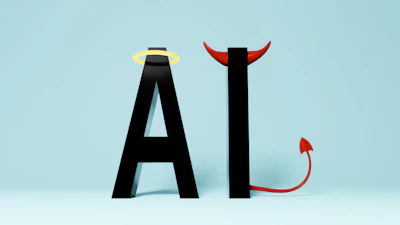
AI is reshaping cybersecurity in two directions simultaneously. AI is a powerful defensive tool for security teams, but it's also being actively weaponized by the people they're defending against. Security teams are under more pressure than ever, and the tools they've relied on weren't designed for the speed, volume or subtlety of modern threats.
What AI Brings to Modern Security Operations
AI doesn’t replace human analysts. Instead, it extends their reach. AI learns what "normal" looks like for a given environment, then flags deviations. This capability fundamentally changes what security teams can catch.
AI is being embedded into security operations centers (SOCs) to do three things that human analysts and traditional tools struggle to scale:
- Automate detection across enormous data volumes.
- Triage and prioritize alerts so analysts focus on what actually matters rather than drowning in noise.
- Accelerate response times by correlating signals across systems that wouldn't otherwise be connected.
In SOCs, AI can analyze massive volumes of events and correlate seemingly unrelated signals into coherent incident narratives, reducing the manual analysis burden significantly. It excels at reducing false positives by using pattern recognition, contextual awareness and continuous learning. These are capabilities that static rule-based tools don't have.
AI can also help analysts across all experience levels. Junior analysts can handle more complex tasks because AI provides guided response steps and translates threat data into plain language. More senior analysts can use AI to synthesize incident context so they have a clearer, more complete picture. This enables them to make more informed decisions about escalations, containment and incident declarations.
The Insider Threat Problem AI Is Built to Solve
Insider threats are on the rise. In 2024, 83 percent of organizations experienced at least one insider attack, whether that was mistakes, stolen credentials or deliberate malicious acts. Malicious insiders can pose a greater risk to IT security than external actors. AI is making insider threats harder to catch because it gives bad actors better tools for deception. It’s easier to make believable deepfakes, phishing emails and synthetic credential use with AI.
Traditional security tools often fail against insider threats because they're built to match known signatures and block known bad actors. A trusted employee, contractor or compromised account doesn't look malicious until behavior changes. That behavioral shift is exactly what AI is designed to detect.
AI builds individual behavioral baselines for users, devices and systems, then flags deviations in real time. For example, someone might access files outside of normal hours, log in from an unusual location or initiate a bulk data transfer when they’ve never done that before. AI can notify the cybersecurity team to look more closely at the situation.
AI-Powered Threats and a Widening Attack Surface
AI is available to everyone, including bad actors. It enables attackers to scale phishing campaigns with hyperpersonalized lures, generate adaptive malware that adjusts to evade detection and create convincing deepfakes for identity fraud. In fact, 47 percent of organizations cite advances in generative AI as their primary cybersecurity concern.
The threat landscape is expanding in scope as well. More bad actors are attacking operational technology and industrial control systems instead of traditional IT environments. To properly defend against these attacks, AI-powered defense strategies need to extend beyond the conventional IT perimeter.
Cybersecurity professionals also need to be aware of shadow AI, which involves unauthorized, unregulated AI use. One in five organizations had a breach due to shadow AI, and those with high usage had breach costs that were $670,000 higher on average.
AI is vital for security teams navigating a threat environment that's become increasingly complex, fast-moving and deceptive. It’s a force multiplier that allows skilled analysts to do more with the expertise they already have.
Incorporating AI into cybersecurity strategies can help companies close the gaps due to insider threats.
Lou is the Senior Editor at Revolutionized, specializing in writing about Technology, Computing, and Robotics.