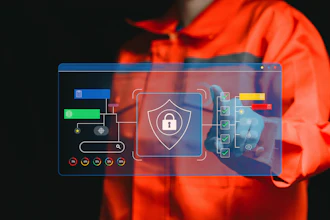
Industry 4.0 is reshaping manufacturing by linking machines, data and people for more connected operations. A secure smart factory means designing those connections to safeguard production and intellectual property from theft and disruptions. With integrated security measures from the outset, companies can capture the efficiency gains of new technology without incurring unnecessary risk.
Internet of Things (IoT) devices — from smart controllers and cameras to edge computers — form the sensory layer of the modern factory. Each device can collect streams of data that improve uptime and efficiency. These connections are already massive in scale and will continue to grow.
Market research predicts the number of IoT devices will more than double, from 19.8 billion in 2025 to 40.6 billion by 2034. The more network devices there are, the larger the attack surface becomes, and it is only a matter of time before a breach compromises a factory’s operation.
Successful data breaches are extremely costly and often highly disruptive. A single compromised device can quickly cascade into downtime, stolen intellectual property or expensive recoveries. Keeping the IoT layer secure starts with operational steps built into procurement and daily practice, which can include the following actions:
- Maintain an up-to-date inventory of your devices and firmware.
- Segment IoT traffic from corporate IT.
- Assign a unique identity to your devices to prevent anonymous devices from becoming footholds for malicious activity.
- Pair proactive patch and life cycle planning with continuous monitoring tuned to operational technology (OT) behavior.
- Codify responsibilities and develop an incident response plan that includes OT recovery.
Safeguarding the Intelligence of a Smart Factory
Artificial intelligence (AI) and machine learning (ML) now sits at the heart of many smart factories, transforming sensor data into real-time decisions that keep lines moving. These systems enable factories to analyze vast data streams of machine and process data, optimizing production and reducing downtime. In practice, this means AI can automatically adjust workflows after analyzing information on supply and demand.
For example, AI tools can adjust line speed or reprioritize batches to accommodate sudden order changes. This automation is among the many reasons why 95 percent of manufacturers worldwide have invested in AI or plan to implement tools in the next five years.
However, operational shifts bring AI-specific risks. Cyberattacks often target training data and models by poisoning data or introducing adversarial inputs that induce incorrect outputs. Any attack can degrade model accuracy or expose sensitive data without monitoring in place.
Defending AI begins with clear governance and life cycle practices, including:
- Defining clear ownership of data and models.
- Enforcing strict access controls and authentication at model endpoints.
- Requiring provenance and versioning so training data and updates are auditable.
- Implementing rigorous validation and adversarial testing alongside anomaly detection and encrypted handling of sensitive training data.
- Incorporating every governance and security strategy into your incident response plans.
Fortifying the Cloud in a Smart Factory
Cloud services provide access across all manufacturing departments. They collect and store telemetry from machines, run analytics and make centralized backups and remote monitoring possible. Due to these capabilities, manufacturers are steadily investing in public cloud use as they modernize their operations and integrate shop-floor data with enterprise systems.
However, that convenience can bring misconfigured storage, overly permissive identities and gaps between multiple providers. These risks create obvious targets for attackers, and the number of cloud intrusions is rising rapidly. CrowdStrike reported a 95 percent increase in cloud environment intrusions in 2023.
Part of the problem is the shared-responsibility model many vendors use. Cloud providers secure the infrastructure while customers remain responsible for protecting data, identities and application configuration. This gap often causes confusion unless it is explicitly mapped and tested.
Fortifying the cloud starts with simple, repeatable discipline. The following steps can help secure the cloud:
- Treat cloud security as collaboration with your provider.
- Inventory and classify factory data before it moves to the cloud.
- Enforce strong identity and access controls with least privilege and multi-factor authentication.
- Encrypt sensitive telemetry in transit and at rest.
- Enable continuous logging and automated posture checks to quickly identify misconfigurations.
Smart factory technologies deliver tangible benefits, and those gains persist when security is an integral part of the plan. Practical steps keep risk manageable without blocking innovation. As a result, security can become an operational discipline that enhances manufacturing productivity and resilience.
Lou is the Senior Editor at Revolutionized, specializing in writing about Technology, Computing, and Robotics.