Teradyne, a provider of automated test equipment and advanced robotics systems, today announced a strategic investment in Bright Machines, a microfactory manufacturer. The investment is part of a strategic collaboration that will integrate Teradyne robotics and test technologies with Bright Machines’ software-defined manufacturing platform and advancing AI infrastructure manufacturing.
AI infrastructure is driving one of the largest electronics manufacturing buildouts in recent history, and manufacturers are placing a premium on lines that can be reconfigured in software as product designs refresh.
Based in North Reading, Massachusetts, Teradyne owns cobot manufacturer Universal Robots and MiR, which manufactures autonomous material handling robots. The company supplies robotics and test technologies that make high-mix, high-value electronics production possible.
Bright Machines brings a unique software-defined manufacturing platform spanning design, robotics, automation, inspection, material movement, production intelligence and operations, with a history of more than 130 microfactory deployments across more than 10 countries as well as active AI infrastructure production in the United States.
"Physical AI is changing what is possible on the factory floor, and Teradyne and Bright Machines are partnering to accelerate this evolution," said Shantnu Sharma, chief development officer, Teradyne. "The combination of Bright Machines depth in software-defined manufacturing, and Teradyne’s decades of experience in robotics and test gives companies building AI infrastructure a faster path from design into production, with data behind every unit they build."
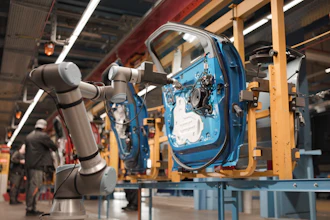
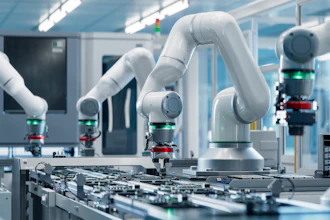
The companies intend to evaluate integrating Teradyne technologies into Bright Machines manufacturing environments, including precision robotic assembly, robotic loading and unloading of test equipment, and autonomous movement of materials across the factory.
The central idea behind the partnership is deployment in real-world environments, where the Bright Machines manufacturing platform, Universal Robots collaborative robots, and Teradyne board test systems would operate together on a production floor.
Each produces a distinct stream of information: assembly and inspection data, robot and material-movement data, and electrical test results. By connecting these data streams, customers can maintain an end-to-end production data thread linking design decisions, assembly execution, and electrical performance.
“What limits automation today is not what a robot can physically do but how much engineering it takes to tell it what to do,” said James Davidson, chief AI officer, Teradyne. “When a robot can pick up a new task in hours instead of being re-engineered over weeks, high-mix, short lifecycle production becomes the default. Once build data and test data sit in the same loop, the line can correct itself quickly.”
AI infrastructure manufacturing is demanding: product complexity is high, design cycles are short, quality requirements are stringent, and schedules leave little room for rework.
“The next generation of AI infrastructure calls for a manufacturing approach that is more automated, software-defined, data-driven, and responsive to change,” said Sviat Dulianinov, CEO, Bright Machines. “Teradyne's expertise, and the investment that comes with it, helps us validate that approach.”
Manufacturers serving this market increasingly value an integrated approach spanning manufacturing design, intelligent robotics, autonomous material movement and inspection, and end-to-end production intelligence, delivered as one coordinated system. Together, Bright Machines' software-defined manufacturing platform and Teradyne's robotics and test portfolio aim to bring these pieces together to lead AI infrastructure buildouts.
“Manufacturing is where AI becomes physical,” said Lior Susan, founder and CEO of Eclipse and co-founder and chairman of Bright Machines. “The AI buildout will be won by companies that can turn increasingly complex hardware into production quickly, reliably and at scale.”