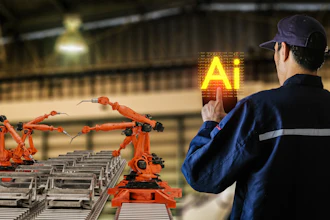
Artificial intelligence has upended many industries and activities, including computer-aided design. This technology could save time and improve accessibility while optimizing outcomes. How is CAD AI changing manufacturing and enhancing designers' workflows?
1. Accelerate CAD Design Creation
Many companies developing AI-enabled CAD tools seek ways for users to save time without limiting quality. One example comes from a startup called Backflip AI, which emerged from stealth mode in early 2025. It is a plug-in and stand-alone app that turns data from 3D scanners into fully parametric CAD models.
The company's CEO emphasizes that the goal is not to force users to drastically change their CAD workflows. Instead, the product turbocharges current processes. Users can convert STL files and scanned meshes into editable models without switching between software.
After people upload their STL files, the cloud-based GPU processor creates four parametric variations of a part and enables users to select the most accurate version. Based on that choice, the tool automatically rebuilds the model, along with a full feature tree. These capabilities could significantly shorten downtime, which often costs manufacturers millions of dollars and severely disrupts operations.
This innovation could eliminate the need to reverse-engineer parts that break, even if no digital models of them exist. Because users can make edits after completing the initial scans, they save time by not needing to redraw everything with each iteration. Although the company initially released its product for SolidWorks, executives plan to eventually make it available to every engineer, regardless of their chosen software.
Users also get step-by-step insights into a component's particulars. The associated reconstruction data about cuts, extrudes, and patterns encourages people to modify and learn from these parts and develop their engineering-related thought processes. Because STL files are native to stereolithography CAD programs, they are widely known and excellent teaching tools.
2. Provide Real-Time Support or Corrections
Even the most skilled and seasoned designers appreciate suggestions to support their creative processes. Those insights encourage them to scrutinize their designs differently than they otherwise might due to the external feedback.
In October 2025, PTC announced AI-driven features for its cloud-native CAD software. The company embedded the technology directly in the design environment, creating a seamless experience for users feeling curious about how it might positively impact their workflows. These product updates deliver step-by-step suggestions, troubleshooting and reminders of best practices to help them confidently achieve their best work.
One user reports that the conversational interface simplifies query refinement and enables finding features faster. That mechanical engineer also appreciates the relevant and trustworthy answers that make design workflows more efficient.
PTC's developers will build upon the currently available AI features by releasing intelligent design agents that help people interact with a model's metadata, solve model-related problems and boost productivity while reducing repetitive operations.
The manufacturing industry has a long and ongoing history of pursuing innovation to improve processes. Sometimes that means having a machine alter its movement in real time to avoid producing parts that do not meet specifications. Then, there is a better chance of a company maintaining tight quality control because things cannot slip through the cracks.
Some laser programming software can detect parts or flag misaligned components which makes the machine pause, stop or take other actions based on the feedback. Whether through real-time AI CAD design support or suggestions for changes that occur after fabrication has begun, those insights prevent wasted material and time.
3. Make AI in CAD Modeling More Accessible
Becoming an expert in CAD modeling software takes time and skill development. A new approach uses artificial intelligence (AI) to bypass that difficult learning process. One startup is offering a text-to-3D app for people who have great ideas but aren’t able to master professional design software.
The founders initially focused on engineers rather than designers for their target market. However, the tool's AI models improved faster than expected, leading those behind the effort to plan on releasing a feature that provides professional-grade CAD models to people who otherwise do not have the ability to create them.
The product initially worked by enabling people to enter text prompts to get the desired results. The forthcoming AI updates will be even more advanced by letting users select different parts of a three-dimensional object and initiate conversations about it.
People familiar with the tool say it will bring CAD modeling to a larger audience by working faster and more simply than its counterparts. The company’s CEO disclosed that tens of thousands of individual users already interact with the product, many of them paying for standard or pro plans that unlock various features.
Beta testers are also trying options designed to support mechanical engineers with repetitive tasks, such as applying one change to multiple CAD files. These professionals can then create parametric designs in popular programs and streamline their most time-consuming tasks.
4. Bring CAD Design Understanding to AI Agents
Tech enthusiasts regularly discuss the rise of AI agents, which complete tasks for their users. These technologies remain in the relatively early stages, but researchers have explored how they could expand AI CAD design through agentic applications.
In one example, engineers hope to reduce the CAD learning curve by developing an AI model that uses relevant software similar to how humans do. It does this after reviewing a two-dimensional sketch of the desired object. After getting that data, it interacts with design tools to create it.
Those involved with the project believe it could make CAD design more accessible to a broader audience while simultaneously supporting individuals who already understand its principles and want to enhance their workflows. They initially examined a dataset of CAD creations made by humans but realized the content was too advanced for models to understand because they lacked the necessary context. The developers solved the matter by creating a system that translated high-level commands into user interface interactions.
The group eventually created more than 41,000 videos of CAD objects designed by people, with each of the design decisions described in real time to indicate the keyboard actions or clicks the human made. This data allowed the model to understand how different user interface interactions can generate specific designs.
It may take a while for CAD-enabled AI agents to reach the mainstream. Still, developments like this one show why they could begin gaining momentum in 2026 and shape the foreseeable future.
AI Facilitates New Ideas
Whether people encounter AI in CAD modeling within the design phase or elsewhere, these examples highlight the many ways it will continue to influence their processes. Even those who are hesitant about working with the technology will likely find fascinating ways to embrace the possibilities if they keep their minds open.